


Post Category


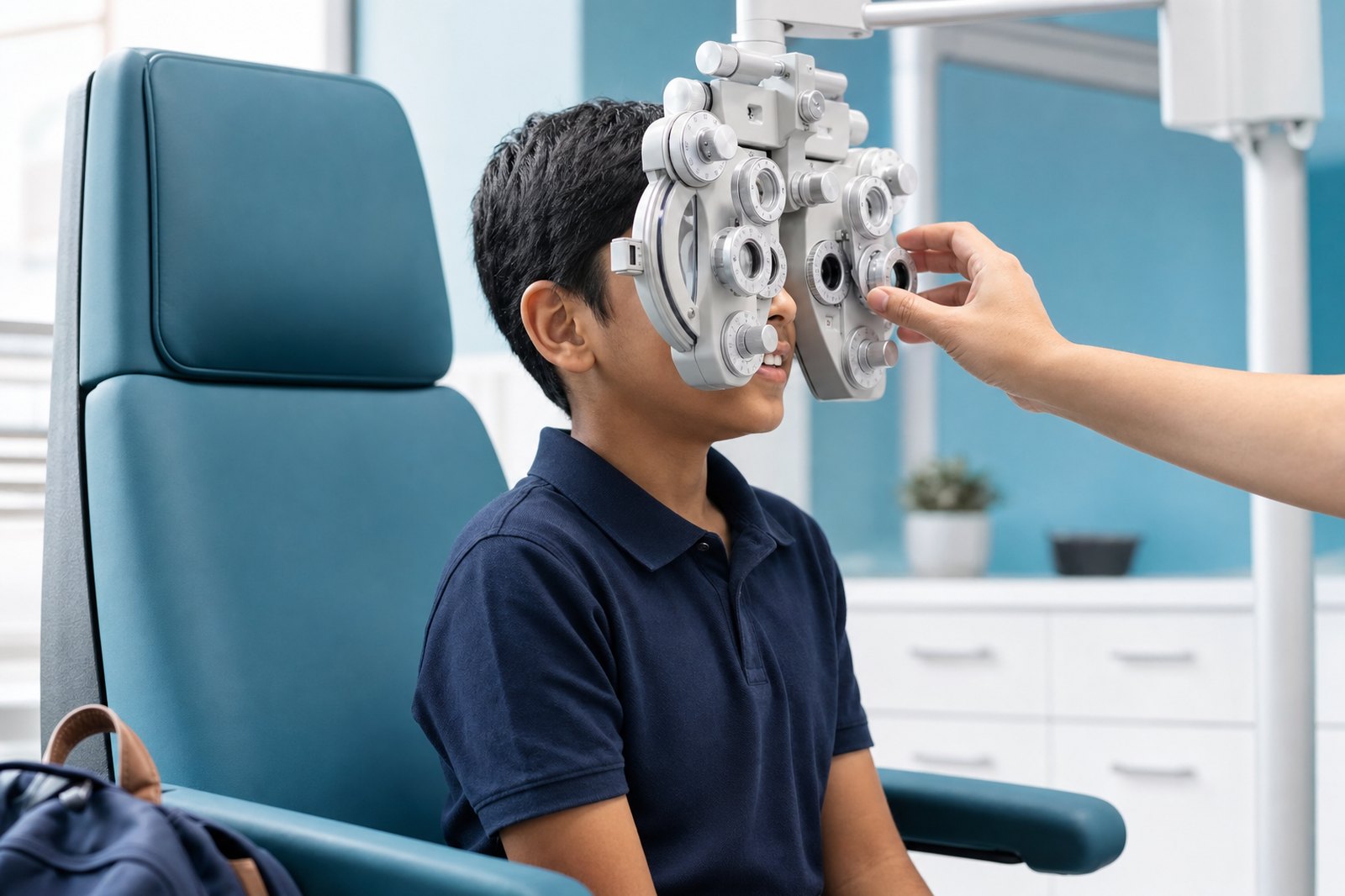
You may have heard that glasses will make a child's eyes worse. This is not true. Standard glasses correct blurry distance vision, but they also do nothing to slow the underlying eye growth that drives nearsightedness. That second point is the one most parents never hear.
Back-to-school season is when many Boca Raton families first notice a problem: a child squinting at the whiteboard, sitting closer to the TV, or holding the iPad a few inches from their face. This guide explains why childhood myopia is rising, when it becomes a medical concern, and what the evidence says about the options that can slow it in 2026.
Why Childhood Myopia Is Rising
Myopia (nearsightedness) is usually not a problem with the front of the eye. In most children it happens because the eyeball grows too long from front to back, so distant images focus in front of the retina instead of on it. The more the eye elongates during childhood, the higher the prescription climbs.
The trend is global. A widely cited analysis by Holden and colleagues in Ophthalmology (2016) projected that roughly half of the world's population will be myopic by 2050, with close to one billion people highly myopic. The leading drivers are less time outdoors, more sustained near work, and genetics. A child with two nearsighted parents starts with a higher baseline risk.
South Florida parents sometimes assume year-round sunshine protects their kids. It only helps if children are actually outside. Between air-conditioned classrooms, indoor after-school activities, and summer heat that pushes play indoors, many Palm Beach County children spend less time in daylight than their location would suggest.
When Nearsightedness Becomes a Medical Concern
A small, stable prescription is simply a refractive error. Progressive myopia is different: a prescription that keeps climbing year after year, often fastest in younger children. The reason to care is not the glasses themselves. According to the American Academy of Ophthalmology, higher myopia raises the lifetime risk of retinal detachment, and high myopia is also associated with myopic maculopathy, glaucoma, and earlier cataract. Every diopter of progression we prevent in childhood lowers that risk later in life, even if glasses "fix" today's blur. Adults with high myopia should also know the warning signs of retinal detachment.
Signs a Parent Should Watch For
- Sitting closer to the TV or bringing a tablet or book very close to the face
- Squinting at the board or at signs, or complaining of headaches after school
- Rubbing the eyes at the end of the day
- A dip in schoolwork, especially after a growth spurt
Young children often do not complain about blur because they assume everyone sees the same way. The AAO and the American Association for Pediatric Ophthalmology and Strabismus recommend regular vision screening throughout childhood, and a comprehensive exam whenever a child fails a screening or has a vision complaint. Our guide on how often your child should have eye exams covers the schedule in more detail.
How Myopia Progression Is Measured
A school screening can tell you a child does not see the chart well. It cannot tell you how fast the eye is changing. Tracking progression properly involves two measurements:
- Cycloplegic refraction. Children focus so strongly that they can mask or exaggerate a prescription. Drops that temporarily relax focusing give a true reading.
- Axial length. An optical measurement of the eye's length from front to back is now considered the most direct way to track myopia, because elongation is the disease process itself.
Comparing these numbers over time shows whether a child's myopia is stable or progressing, which determines whether active treatment is worth it.
The Evidence-Based Options for Slowing Myopia
No option stops myopia completely, and none reverses it. Each can slow progression, and the right choice depends on age, prescription, lifestyle, and how much daily responsibility a child and family can take on.
MiSight 1 day contact lenses
MiSight 1 day is a soft, single-use daily contact lens with a dual-focus design: the center corrects distance vision, while surrounding rings create peripheral defocus that is thought to reduce the signal for the eye to keep growing. The FDA approved it in November 2019 to correct myopia and slow its progression in children aged 8 to 12 at the start of treatment, with wear recommended at least 10 hours a day, six days a week.
In the three-year randomized trial behind the approval (Chamberlain et al., Optometry and Vision Science, 2019), children wearing MiSight had 59% less change in prescription and 52% less eye elongation than children in standard daily lenses. Because it is a contact lens, hygiene and follow-up matter; contact lens wear always carries a small risk of infection.
Essilor Stellest eyeglass lenses
This is the biggest change since many parents last read about myopia control. On September 25, 2025, the FDA authorized Essilor Stellest as the first eyeglass lenses in the U.S. to slow myopia progression, for children 6 to 12 years old at the start of treatment. A clear central zone corrects vision while rings of tiny raised lenslets provide peripheral defocus. In the two-year study the FDA reviewed, progression slowed by 71% measured by prescription and 53% measured by eye length compared with single-vision lenses. Some children noticed blur or halos, and no serious adverse events were reported.
For children too young for contacts, or not ready for them, this makes myopia control far more accessible.
Low-dose atropine eye drops
Atropine drops in very low concentrations (commonly 0.01% to 0.05%) are placed once at bedtime. The AAO notes that many pediatric ophthalmologists now prescribe them. The strongest early evidence came from the LAMP study in Hong Kong (Yam et al., Ophthalmology, 2019), which found a concentration-dependent effect, with 0.05% slowing both prescription change and eye growth the most over one year while being well tolerated.
The results in U.S. children have been more mixed. In the three-year CHAMP trial (Zadnik et al., JAMA Ophthalmology, 2023), 0.01% atropine met its primary goal but 0.02% did not. A separate U.S. trial by the Pediatric Eye Disease Investigator Group (Repka et al., JAMA Ophthalmology, 2023) found no benefit of 0.01% over placebo.
It is important for parents to know that, as of September 2026, no low-dose atropine product is FDA-approved for myopia in the United States. The FDA has declined two applications, and an FDA advisory committee is scheduled to review a 0.01% atropine application on October 30, 2026. Until a product is approved, low-dose atropine is prescribed off-label and prepared by a licensed compounding pharmacy. Drops do not correct blur, so children still need glasses or contacts. Side effects at low doses are usually mild: some light sensitivity from slightly larger pupils and, at higher concentrations, mild near blur.
Orthokeratology (ortho-k)
Ortho-k uses custom rigid gas-permeable lenses worn overnight to gently flatten the cornea, so a child can see clearly during the day without glasses or contacts. The effect is temporary and reverses if the lenses are stopped. A meta-analysis in PLoS One (Sun et al., 2015) found about 45% less eye elongation over two years compared with standard correction.
The trade-off is risk and responsibility. The AAO warns that sleeping in contact lenses carries a risk of serious, vision-threatening infection, so ortho-k demands meticulous lens care, a committed parent, and reliable follow-up. It is not a fit for every child.
What About Regular Glasses, Bifocals, and Multifocal Contacts?
Standard single-vision glasses and contacts correct blur but do not slow progression. Bifocal glasses and some multifocal soft contact lenses have shown modest effects in studies, but the evidence is weaker than for the options above. Combining treatments, such as atropine with a specialty lens, is an area of active research and should be decided case by case.
Habits Every Family Can Start Now
- Time outdoors. In a large study of Australian schoolchildren (Rose et al., Ophthalmology, 2008), more total time outdoors was linked to less myopia, independent of sports. Many experts suggest aiming for about two hours of daylight a day, with sun protection.
- Break up near work. The 20-20-20 habit (every 20 minutes, look 20 feet away for 20 seconds) gives focusing a rest. Our digital eye strain guide has more screen-time tips.
What to Expect at a Myopia Evaluation at West Boca Eye Center
A myopia visit starts with a comprehensive, dilated eye exam to confirm the eye is healthy and rule out other causes of blur, such as amblyopia. From there we measure the prescription, review family history and how fast your child's vision has been changing, and talk through which options fit your child. Our eyeglasses page covers lens materials for kids. Not every myopia treatment is provided in every office; if the best fit for your child is a specialty option we do not provide in-house, we will say so plainly and help you find it.
Cost and Insurance
Coverage varies widely. Vision plans may help with exams and glasses, while specialty lenses, compounded atropine, and ortho-k are often partly or fully out of pocket. We recommend checking your specific plan before starting.
When to Bring Your Child In
- Any new complaint about seeing the board, the TV, or signs
- A prescription that has changed noticeably within a year
- Any child with one or both parents who are nearsighted
- A failed school or pediatrician vision screening
West Boca Eye Center serves families from Boca Raton, Delray Beach, Boynton Beach, Deerfield Beach, Parkland, and Coral Springs. Later in life, some nearsighted teens and adults explore vision correction; our EVO ICL vs LASIK guide explains those options. To schedule an evaluation with Dr. Brent Bellotte and our team, contact us.
Frequently Asked Questions
At what age can my child start MiSight?
MiSight 1 day is FDA-approved for children aged 8 to 12 at the start of treatment. For children 6 to 7, or those not ready for contacts, Essilor Stellest eyeglass lenses are now FDA-authorized from age 6.
Do atropine drops make pupils huge, like a dilated exam?
No. Low-dose atropine enlarges the pupil only slightly. Some children notice mild light sensitivity, and sunglasses or a hat usually help.
Will ortho-k permanently reshape my child's cornea?
No. The reshaping is temporary. If lens wear stops, the cornea returns to its original shape, typically over days to weeks.
Is myopia control covered by insurance in Florida?
Sometimes, partially. Coverage depends on the plan and the treatment. Exams and standard glasses are more often covered than specialty lenses or compounded drops.
Does more outdoor time really help?
Yes. Studies consistently link more time outdoors with lower myopia risk, and the AAO calls outdoor time a first step for prevention.
What happens if we do nothing?
Many children will keep progressing until their late teens or early twenties. Higher final prescriptions carry higher lifetime risk of retinal detachment and other complications.
Important Safety Information
This article is general education, not medical advice. Every myopia control option carries some risk. Contact lenses, including MiSight and especially overnight ortho-k lenses, carry a risk of eye infection that can threaten vision; strict hygiene and regular follow-up are essential, and a red, painful, or light-sensitive eye needs prompt care. Low-dose atropine is not FDA-approved for myopia in the U.S. and must be prescribed by a licensed provider and prepared by a licensed pharmacy. Choose a treatment only after an in-person exam, not an online quiz.
Glasses sharpen a nearsighted child's vision but do not slow it. A Boca Raton guide to MiSight, Stellest lenses, low-dose atropine, and ortho-k.
Book an appointment
Fill out the form below and our staff will reach out to you quickly to fully book your appointment and receive all of your necessary information.

Specializing in modern cataract surgery.
Located 1/2 miles North of West Boca Medical Center on Glades Road, directly behind Macy's Furniture Gallery.
West Boca Eye Center
9325 Glades Road, Suite 201.
Boca Raton, FL 33434